
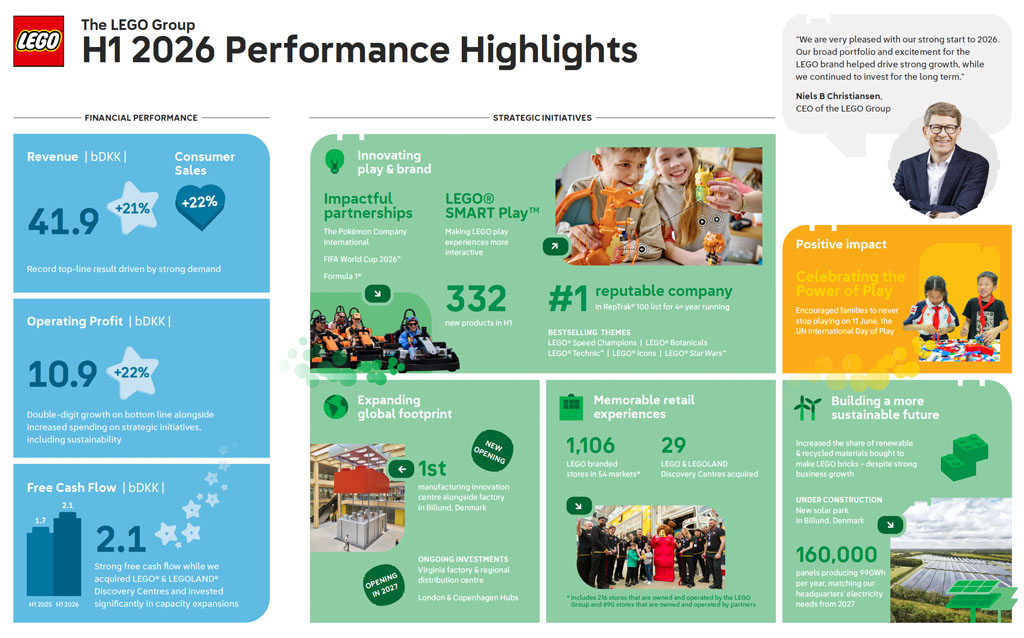
LEGO has opened the second half of 2026 with another reminder that it is not just leading the toy business, it is widening the gap. The company's newly released first half results show revenue up 21 percent year over year to DKK 41.9 billion, consumer sales up 22 percent, and operating profit up 22 percent to DKK 10.9 billion. Net profit climbed even faster, rising 32 percent to DKK 8.6 billion, a figure that stands out even more because it builds on what was already a record 2025.
The headline numbers came through in LEGO's official financial release and were quickly picked up by major fan media, with The Brick Fan laying out the key results and Jay's Brick Blog highlighting just how unusual it is to see this kind of growth continue after such a strong prior year. That context matters. A lot of companies can post a rebound year. Doing it again, while also gaining market share, is a much tougher trick.
What jumps out first is the breadth of the business. LEGO said demand was strong across the Americas, Western Europe, CEEMEA, and Asia Pacific, which suggests this was not a one-region spike or a short lived product bubble. The best selling themes in the first half of the year also paint a useful picture of where the momentum is coming from: Speed Champions, Botanicals, Technic, Icons, and Star Wars. That is a wide spread of interests, from car culture and display builds to evergreen licensed sets and adult collector favorites.
LEGO also launched more than 330 new products in the first six months of the year. That kind of output only helps if shoppers are actually responding, and the sales growth says they are. The company specifically pointed to excitement around partnerships including Formula 1, FIFA World Cup 2026, and KPop Demon Hunters, while continuing to invest in broader play initiatives like SMART Play. In other words, LEGO is not relying on one breakout hit. It is feeding different audiences at the same time, then backing that up with retail execution and a marketing machine that keeps the brand culturally visible.
Profitability is the other big story here. Operating profit rose in line with revenue, but net profit ran ahead at 32 percent growth, which tells you LEGO is still converting demand into real earnings at a very healthy rate. At the same time, the company says it is keeping spending high on long term priorities rather than simply harvesting the upside. That includes sustainability work, new factory capacity, store growth, and the acquisition of 29 LEGO and LEGOLAND Discovery Centres from Merlin Entertainments. Cash flow from operating activities increased 47 percent to DKK 8.6 billion, while free cash flow still improved to DKK 2.1 billion even with those heavier investments.
That balance between growth and reinvestment may be the most important takeaway for collectors and industry watchers alike. LEGO is clearly selling a lot of sets right now, but the company is also pouring money into the things meant to keep that momentum going, from manufacturing upgrades to renewable energy projects. It opened the Kornmarken Campus in Billund as a dedicated manufacturing innovation center, continued work on its Virginia factory and regional distribution center, and pushed further into paper based packaging and solar expansion. None of that is flashy in the same way a major set reveal is flashy, but it is part of why the business keeps compounding.
The retail side looks strong too. LEGO says it now has 1,106 branded stores worldwide after opening more locations in the first half of the year, while also expanding partnerships with retailers and rolling out interactive in store demos. That matters because the modern LEGO business does not live only on shelves or only online. It thrives when it can turn products into experiences, whether that is a destination store, a branded event, or a fandom moment that travels across social media.
For Hypebrickz readers, the easiest way to read these results is this: the current LEGO boom still has real legs. The strongest categories remain strong, newer partnerships are landing, and the company is making enough money to keep scaling without visibly pulling back on future investment. If the first half is this strong, the second half of 2026, traditionally the bigger sales window, could push LEGO even closer to another landmark year.
Source context: primary reporting from The Brick Fan, with additional financial framing and analysis echoed by Jay's Brick Blog based on LEGO's official H1 2026 results release.

